
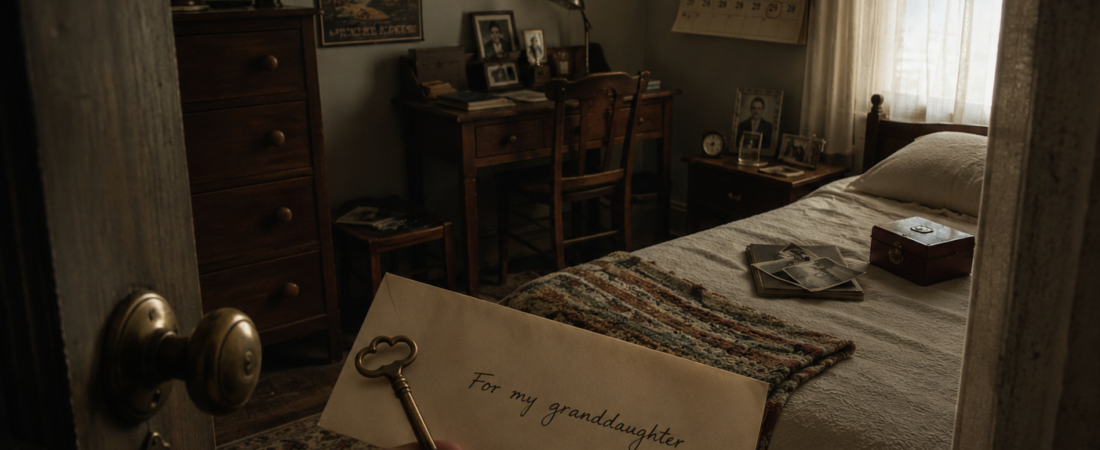
My grandmother had one rule.
Never open the bedroom at the end of the hall.
Not as a kid.
Not as an adult.
Not even after Grandpa died.
The door stayed locked.
Always.
Whenever someone asked about it, she’d smile.
“Some things belong to yesterday.”
That was the end of the conversation.
Growing up, I imagined everything.
Hidden money.
Old family jewelry.
A ghost.
By the time I was thirty, I’d stopped wondering.
Then Grandma turned ninety-two.
She asked me to visit alone.
No parents.
No cousins.
Just me.
She was weaker than I’d ever seen her.
She reached into the drawer beside her bed.
Pulled out an old brass key.
“I don’t need this anymore.”
I stared at it.
“The bedroom?”
She nodded.
“But promise me one thing.”
“Don’t open it until after I’m gone.”
Three weeks later…
She passed away peacefully.
The funeral came and went.
Everyone gathered back at the house.
People laughed.
Shared stories.
Sorted old photographs.
No one mentioned the locked room.
They assumed it would stay that way forever.
I waited until everyone left.
Walked down the hallway.
The key fit perfectly.
The door creaked open.
The room looked untouched.
The bed was made.
The curtains were drawn.
A calendar still hung on the wall.
It was opened to…
August 1983.
Like time had stopped that day.
Then I noticed something sitting on the pillow.
A single envelope.
It had my name on it.
In handwriting that wasn’t my grandmother’s.
I recognized the handwriting immediately.
It was my mother’s.
The problem was…
The letter was dated six years before I was born.
My hands started shaking.
Inside was one sentence.
“If you’re reading this, she finally told you the truth.”
The rest explained everything.
The room hadn’t belonged to my grandparents.
It had belonged to my uncle.
The brother my mother almost never talked about.
When he was twenty-three, he disappeared during a hiking trip.
Everyone believed he had died.
There was never enough evidence to declare exactly what happened.
Grandma couldn’t bring herself to change the room.
Not one picture.
Not one shirt.
Not one book.
She kept it exactly as he’d left it.
Every week for forty-three years, she dusted it.
Changed the bedsheets.
Opened the window for an hour.
Then locked it again.
Not because she thought he’d come home.
Because she couldn’t bear the idea that the last place he’d called home would disappear.
The letter wasn’t about a hidden fortune.
Or a family scandal.
It was an apology.
My mother wrote that she’d always been angry with Grandma for refusing to let go.
She thought the room kept everyone trapped in grief.
As she got older…
She realized Grandma wasn’t preserving the room.
She was preserving her son.
Not for herself.
For the people who never got to know him.
I spent the afternoon looking through photo albums.
Old report cards.
Letters he’d written from college.
A half-finished model airplane on his desk.
For the first time…
He felt like family.
Not just a name I’d heard twice a decade.
Before I left, I locked the room one last time.
Not because I wanted to keep it closed forever.
But because I finally understood why she’d needed it closed for so long.
Sometimes a locked door isn’t hiding a secret.
It’s protecting a memory that someone isn’t ready to lose.